
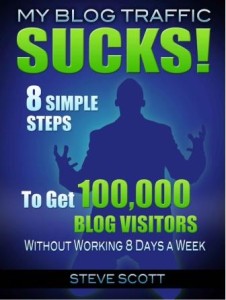
 For any “How To” book to be useful, it has to be at the right level for your stage of development in the technique you are learning. Too far ahead and you won’t understand it. Too far behind, and you already know the stuff.
My Blog Traffic Sucks is exactly the right level for me: about two steps ahead. I was already doing about 3-1/2 of the 8 techniques, and knew something about two others. The rest was over my head, so I won’t be following Steve Scott’s footsteps that far.
The greatest value in this book is that, at its level, it is comprehensive. I have hundreds of websites bookmarked, telling me ways to improve my blog, my sales, and my writing. I never look at them. Continue reading “How the Book “My Blog Traffic Sucks!” Helped This Author”
 In this snippet of overheard conversation, the Mentor runs the Student Writer through the process of using
  So you’re a beginning writer, and you loved writing the book, but now you’re faced with the dreaded publishing process. Becoming an independent author sounds just too complex, but you don’t really know how to attract an agent or a traditional publisher either.
 Fantasy writers and readers have a reputation for being just slightly soft in the head. I mean, what adult believes in magic? But wait a moment. All forms of writing ask for a suspension of disbelief by the reader, and there are elements of “magic” in most genres. That’s the joy of reading. By creating an imaginary world for us, the writer pushes us towards a sense of wonder. But it is easy for an author to overuse the readers’ belief in the more wonderful story elements. Since they are…well…magical, authors may think they don’t have to follow the usual rules. But use of magic has rules of its own, because that is where the writer is in the most danger of pushing readers into disbelief. The following are a few principles of writing “magic” of all sorts that authors might wish to consider.