
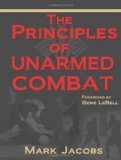
The Fighting in Writing by Mark Jacobs

The Principles of Unarmed CombatAfter recently participating in a thread on a book discussion group regarding great literary action scenes, it got me to thinking of what are the best written fight scenes in literature and just what it is that makes a great fight scene on the written page.

The latter questions is, perhaps, the more difficult one to answer. A sense of knowledgeability on the part of the author leading to some realism in the scene is obviously helpful. A great example of a writer who has “walked the walk” is Thom Jones. A former U.S. Marine and amateur boxer, Jones has written some brilliant short fiction, a few revolving around the dark places of human experience that combat can lead to. His story, The Pugilist at Rest, contains a short but memorable description of what it’s like to engage in a boxing match you’re not quite prepared for:

“He put me down almost immediately, and when I got up I was terribly afraid. I was tight and I could not breath. It felt like he was hitting me in the face with a ball-peen hammer. It felt like he was busting light bulbs in my face.”

Unfortunately, most authors are not known for their pugilistic skills. As a group, they often tend to be observers and thinkers, rather than doers and brawlers (Besides Jones, there are a few other odd exceptions to this rule. Hemingway was known to step into the ring on occasion but, sadly, “Papa” did not depict that many fight scenes in his work). Consequently, most written fight scenes, at least to the expert observer, lack a sense of veritas. However, there are exceptions to the rule in which even unrealistic fight scenes have been portrayed in gripping passages. Continue reading “The Fighting in Writing by Mark Jacobs”


In the E-reader era…

I saw this article in my local newspaper – http://www.nytimes.com/2012/05/13/business/in-e-reader-age-of-writers-cramp-a-book-a-year-is-slacking.html – borrowed from the New York Times – and I just shook my head. I feel for the writers who commented, really I do. The notion of having to write a novel a year? That’s tough. (Just look at James Patterson. Oh… bad example.)

It’s also an artificial construct. In other words, a lie.

I admire all the writers mentioned, and I do feel bad for them if they feel they have to write 2000 words a day 7 days a week. That’s a lot of words. 730,000 to be precise.  That’s the equivalent of two epic fantasies and a few novels. So, I feel bad.

After all, it’s partly my fault, and the fault of a friend of mine. She writes at least three series for a mid-level publisher and puts out the equivalent of two books a month, much less a year. Her erotic novels put her on the USA Today bestseller list.

Of course, I do have to point out that the one novel a year concept is a creation of the publisher, not the writer. Continue reading “In the E-reader era…”

MOVE IT OR LOSE IT

Author Lin Robinson

Having dwelled, last month, on several posts about “rules” and concepts I advised writers to ignore or at least salt down, I thought I should balance it with some more positive material; tips to help writers work better. It surprises many to learn that I actually have a Bachelor’s degree in Creative Writing. From the University of Washington, to be precise: Go Huskies! But I learned more while writing for a living: meeting deadlines for newspapers, pressure to write better than the staff on magazines, measuring copy against sales figures for catalogs. And in all those classes and decades of exposure to pro writers, I only picked up a bare handful of tips that I feel are useful enough to pass along to others. So, since I rate in top echelons of truly wonderful guys, that’s what I’m going to do. These are things that actually help and actually work. They are additive, rather than prohibitive tips, ranging from truly simplistic to fairly arcane. And both kind of mystical.

I’ll start out at the simple end of the scale, with something that might just seem silly to many. But for some reason it works. I first heard it from the editor of an Army newspaper, and later, almost word for word, while interviewing a great American writer, the late Ross Thomas. Here goes. Continue reading “MOVE IT OR LOSE IT”

About Commitment — A Writing Proposal

When I was invited to become part of the Indies Unlimited staff and write an article every month, I felt surprised and delighted and honored. Then I wanted to vomit. I’m not good with commitment. I tell myself that I like writing too much to be obligated to it, so we’ve just been cohabitating. I write whatever I want to, whenever I feel like it — or not — no pressure.

We have had our periods of exclusivity, and I’ll admit that I used to swing dance every Friday and Saturday night but now I mostly write. Yet the choices leading to now have been more about the moment or an alternative than a decision to make writing a priority. I’d rather research an essay than dance this Friday. I’d rather edit stories than watch TV on Tuesdays. I’d rather work on character development than cook — ever. There were some big concessions, but I never fully committed. Okay, I’ll write a book, but I’m not promising to let anyone read it. Okay, I’ll publish it, but I’m not going to tell my friends about it. Okay, I’ll start a second novel, but if it frustrates me so much I cry, I swear I’ll put it in a drawer and not think twice about it; I can’t handle that kind of drama in my life.

Recently, writing and I have been in a good place. I want to write every week. The stories are humming along, I’m getting ready to publish again, and my next novel is beyond the throw-it-out-the-window stage. For crying out loud, we were in Vegas on vacation and the thing I most wanted to do was write (by the pool and in between concerts, but still…). Isn’t that enough? Why did this proposal have to come now? Continue reading “About Commitment — A Writing Proposal”